
Task Based Fitness
Most of us follow professional athletes in football, baseball, basketball, etc. We see these men and women as they are in the pinnacle of their athletic performance on their respective fields of play. When in off season training, these athletes will perform task-based training. Whether its hundreds of hours of throwing a football, catching fly balls or hitting rebounds; it is task based training. Most of these elite athletes keep this up for less than 5 years! 3.3 years for NFL, 4.5 for NBA and 5.6 for MLB players. Firefighters are the elite athletes of the public sector, but the difference is that most careers span 2-3 decades. In every one of those 20-30 years, firefighters need to be battle-ready with some sort of task-based fitness training program.
No, this blog isn’t about sports, but it is about the fact that firefighters are the unsung hero athletes in todays society. How we train and build muscle memory is how we will will inevitably perform on the fireground. We WILL fall back to out most proficient level of training. If we haven’t been training physically, it will show when it’s “game time”. While there are factors of firefighting we cannot control, like the heat stresses we experience while in turnout gear, we can control our fitness, which can in turn reduce the risks of that heat stress while in turnouts. In addition to on average 100 firefighter fatalities annually with 40% of those being classified overexertion, there were 39,290 fireground injuries annually between 2010-2014. 9,710 of these injuries resulted in lost work time. Overexertion was the leading cause of injury, accounting for 26% of these injuries. Just as in professional sports, task-based training for firefighters can help in the reduction of fireground and training injuries.
A couple of months ago, I unexpectedly threw myself into the on-the-job injury statistics with a pretty bad ankle sprain. I was stepping off the truck and next thing I knew I was on my back wondering what just happened, with an excruciating pain in my ankle. I powered through the firefight, which turned out to be a grass fire, structure fire and 3 outbuildings all fully involved. By the time we were done and back at the firehouse, my ankle looked as if I had replaced it with a purple and yellow softball! As most firefighters do, I brushed it off and stayed the remainder of the shift. By morning, I was in a pretty good deal of pain. I took one shift off and stayed off of it for a few days, keeping it iced and elevated. 6 days later, I was back on the truck. I had only missed one shift, and I attribute that to the fact that I keep myself physically ready for the job through task-based training.
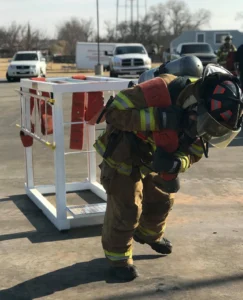
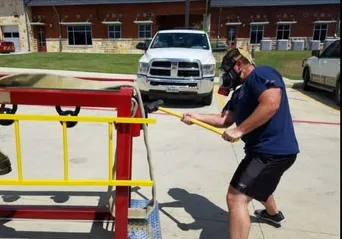
To task-based train for firefighting, we need equipment. Equipment that simulates tasks we would probably encounter while fighting fires. Think of a football tackle dummy. Linemen train tackle drills on the dummy apparatus to be better at their job. Using a Firefit trainer, firefighters can do the same. Stair climbs, hose drags, tool carries, etc. etc. While there are many ways to do that, such as tire drags and strikes, hose dummy drags, taking tools off the truck; we will either have a truckroom full of old tires and such, or we take needed equipment off the trucks. Thats where the Firefit training apparatus comes in. In one compact unit, we can train 7 different tasks in a single circuit, improving our strength and cardiovascular endurance simultaneously. Building strength will help reduce injuries with one compact unit that fits in the corner of most fire stations.
What we have been seeing are heart rates that very closely match what we would find in fireground activities such as advancing a hoseline or hauling tools, which translates to better cardiovascular endurance over time with regular use. In fact, recent UL studies have shown negligible increases in core body temperatures in live fire training evolutions vs. training evolutions using a smoke machine. What this tells us is that we can advance our cardiovascular and physical fitness by training on occasion in clean turnout gear to help us build the endurance we will inevitably need when it’s gametime. At Firefit, we have done the hard work in the research, the SOG building, and turning Firefit into a health and wellness program, and not simply a piece of equipment. Check out Firefit trainers here or on our social media. Instagram@firefittrainer or Facebook@Firefit firefighter fitness trainer.
Stay safe, Randy